
2026 Tata Tiago Facelift: One Car, Three Powertrains, Zero Excuses
By a correspondent who’s spent more hours in Tata’s press cars than he’d like to admit
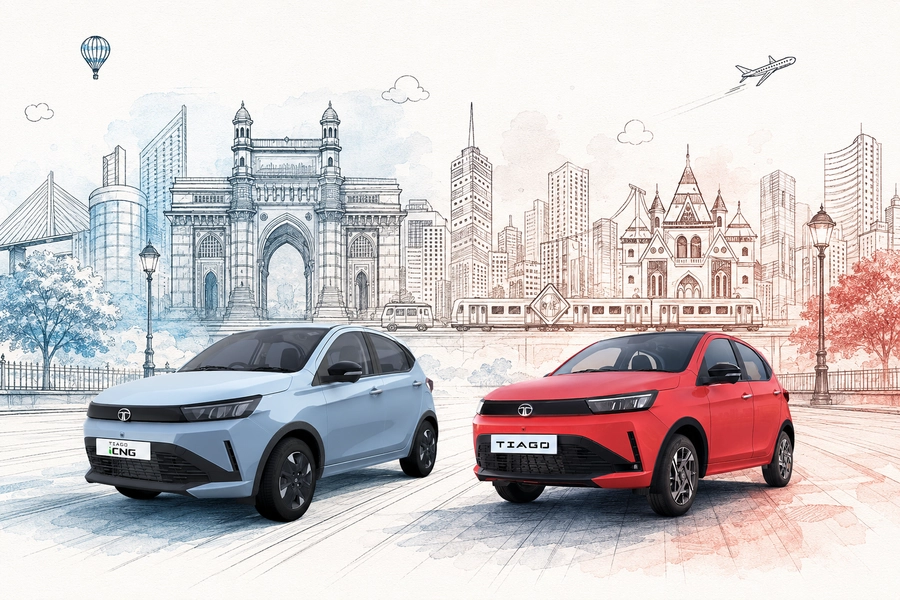
Tata Motors does not do things quietly anymore. The company that once struggled to shake off its “poor man’s car” image has spent the last eight years methodically dismantling that reputation — and with the 2026 Tiago facelift, launched on May 28th, it’s sending a very clear message to the competition.
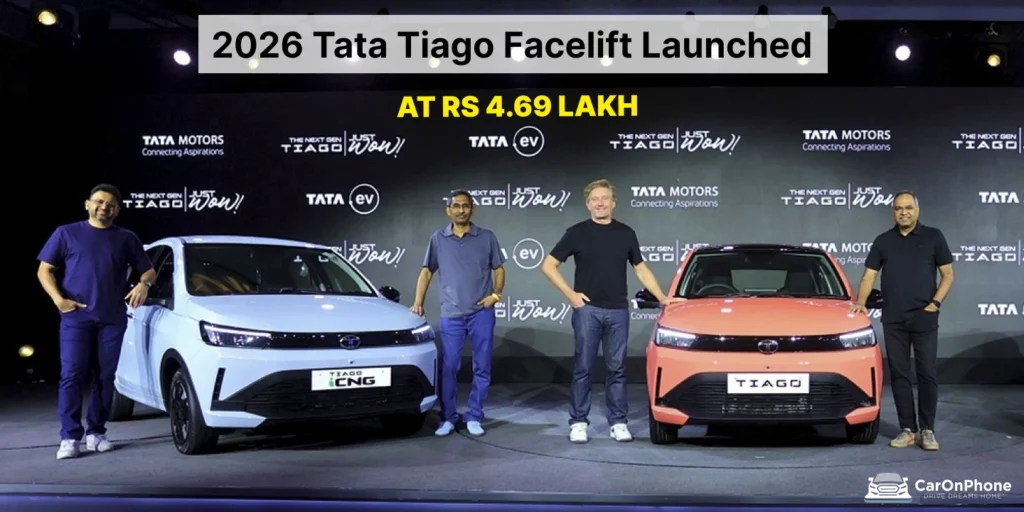
Three powertrains. Petrol, CNG, and Electric. Starting at Rs 4.69 lakh and going all the way to Rs 9.99 lakh. In the same bodyshell. If you’re Maruti Suzuki, that should make you uncomfortable.
The Outside-In Overhaul
Before we get to the engines, let’s talk about the elephant in the room — the old Tiago looked like a budget car. The rounded, inoffensive face never really had a personality. Tata’s design team has fixed that.
The 2026 facelift is sharper everywhere. Slimmer headlamps, a redesigned bumper with a larger air intake, connected LED tail lamps at the back, and a cleaner roofline. The overall silhouette now reads closer to a mini Altroz than the pudgy hatchback it was replacing. New 15-inch alloy designs and black wheel arch cladding round out a look that feels punchy without being try-hard. Six colour options are on offer — Daytona Grey, Pangong Pulse, Pristine White, Pure Grey, Sobo Surge, and Varanasi Vibrance. Points for naming creativity.
Inside, Tata has finally gone flat. The swoopy waterfall dashboard that felt dated from day one is gone. In its place is a cleaner horizontal layout with a 10.25-inch touchscreen, a full digital instrument cluster, a wireless charger, and — genuinely surprising for this segment — a 360-degree camera. Rear AC vents, Type-C charging ports, and paddle shifters on the AMT variants complete a features list that should have no business being in a car at this price. Yet here we are.
The bodyshell has also been strengthened. Tata hasn’t shared specifics yet, but given the 5-star NCAP legacy of the broader Tiago family, that’s a commitment worth taking seriously.
The Petrol: Old Friend, Solid Anchor
1.2L Revotron, 86 PS, 113 Nm | MT & AMT | Rs 4.69 – 7.29 lakh
The 1.2-litre three-cylinder Revotron is not new. It has been under the Tiago’s bonnet since 2016. By this point, the engine has been refined, re-tuned, and improved enough times that its age is more of a reassurance than a limitation.
Eighty-six horses and 113 Nm isn’t going to make headlines. What it does do is move the Tiago around a city with genuine ease, deliver about 19 kmpl on the ARAI cycle with the manual, and behave predictably whether you’re crawling through Andheri at 8am or climbing a flyover in Hyderabad. The three-cylinder buzz at idle is still present — it always will be — but it smooths out once you’re moving.
The AMT has improved considerably over the generations. Early Tiago AMTs were agricultural. The current unit is still no torque-converter, but it’s usable for daily commuting without the constant frustration the earlier versions caused. The addition of paddle shifters on the 2026 model is a smart move — it gives drivers more control without Tata having to spend money on a DCT.
For a first-time car buyer, a young professional buying their own first hatchback, or a family that needs a second car for city use — the petrol Tiago remains a rational, reliable choice. It always was.
The CNG: The Wallet’s Best Friend
1.2L Revotron CNG, 75.5 PS, 96.5 Nm | MT & AMT | Rs 5.79 – 7.99 lakh
Here’s where it gets interesting.
Maruti Suzuki has dominated the CNG segment in India for so long that many buyers simply default to an S-CNG car without thinking twice. The Tiago CNG is Tata’s attempt to change that calculus — and with factory-fitted kits (not aftermarket jugaad) and a 26 km/kg ARAI rating, the argument is credible.
Power drops to 75.5 PS and 96.5 Nm in CNG mode — a reasonable trade-off when CNG is roughly half the per-kilometre running cost of petrol in most Indian cities. If you’re doing 80-100 km a day in Mumbai or Delhi, the savings compound quickly. The math typically works out in the CNG’s favour within 18-24 months of ownership.
What’s genuinely new and worth calling out: the 2026 Tiago CNG AMT gets paddle shifters. First-in-segment. It’s a small detail, but it shows Tata is no longer treating the CNG variant as a stripped-down poverty spec. CNG buyers deserve the same feature parity as petrol buyers. Tata has acknowledged that.
The practical concern with any CNG car remains the same — boot space takes a hit because of the cylinder, and CNG pump availability outside major cities is still inconsistent. If you live in a Tier-1 city and do high daily mileage, the CNG Tiago makes obvious sense. If you regularly drive long distances on state highways, you’ll want to think twice.
The Electric: India’s Most Affordable EV, Still
19.2 kWh: 61 PS, 110 Nm, 226 km range | 24 kWh: 75 PS, 114 Nm, 285 km range | Rs 6.99 – 9.99 lakh
When the Tiago EV launched in 2022 at under Rs 9 lakh, the industry talked about it for weeks. An electric hatchback, from an Indian brand, at a price that actually made sense for real buyers — not just early adopters performing sustainability on Instagram.
The 2026 update doesn’t reinvent the car. It doesn’t need to. What it does is refresh the exterior (the EV now looks noticeably different from the ICE version — a closed grille, a cleaner nose, sharper DRLs), update the cabin with the same dual-screen setup and new features as the petrol siblings, and improve safety credentials.
Two battery options remain. The 19.2 kWh pack claims 226 km of range and the 24 kWh pack claims 285 km. Real-world figures, accounting for AC, traffic, and the way most Indian drivers actually drive, will be lower — expect something in the 180-240 km window depending on conditions. For city use, both are adequate. The larger pack is worth the premium if you occasionally do inter-city weekend trips.
The 0-60 km/h sprint in 5.7 seconds for the larger pack makes the Tiago EV feel genuinely quick in city traffic — quicker than you’d expect from something wearing a budget hatchback badge. That’s the thing about EVs in city conditions: instant torque makes every traffic light feel like a minor victory.
The BaaS (Battery as a Service) pricing is also worth mentioning. At Rs 4.69 lakh upfront on BaaS, the Tiago EV becomes more accessible to buyers who are wary of battery replacement costs down the line. It’s a smart play, and one that Tata has been quietly refining.
The Bigger Picture
Tata is currently the only carmaker in India offering petrol, CNG, and electric versions of the same hatchback under one nameplate, at one dealership, with shared after-sales infrastructure. That is not a small thing.
Most buyers in the sub-Rs 8 lakh hatchback segment are still primarily price-driven. But the decision framework is becoming more complex — fuel costs, charging infrastructure availability, daily commute distance, family size, resale value projections — and the Tiago’s multi-powertrain approach means a buyer doesn’t have to go to four different companies to find the right fit. They can walk into one Tata showroom and make a side-by-side comparison.
That’s a sales and brand argument as much as it is a product argument. And Tata is getting better at both.
Is the 2026 Tiago perfect? No. The cabin plastics are still a notch below what Hyundai offers in the Grand i10 Nios at equivalent prices. The AMT, for all its improvements, still won’t satisfy someone who drives enthusiastically. And the 240-litre boot on the EV will test your spatial reasoning on long road trips.
But at Rs 4.69 lakh for the base petrol? There isn’t a car in the country that offers this feature set, this safety, and this powertrain flexibility at that number.
Tata knows it. And now, so does everyone else.
Prices quoted are ex-showroom, India, as of launch on May 28, 2026.