
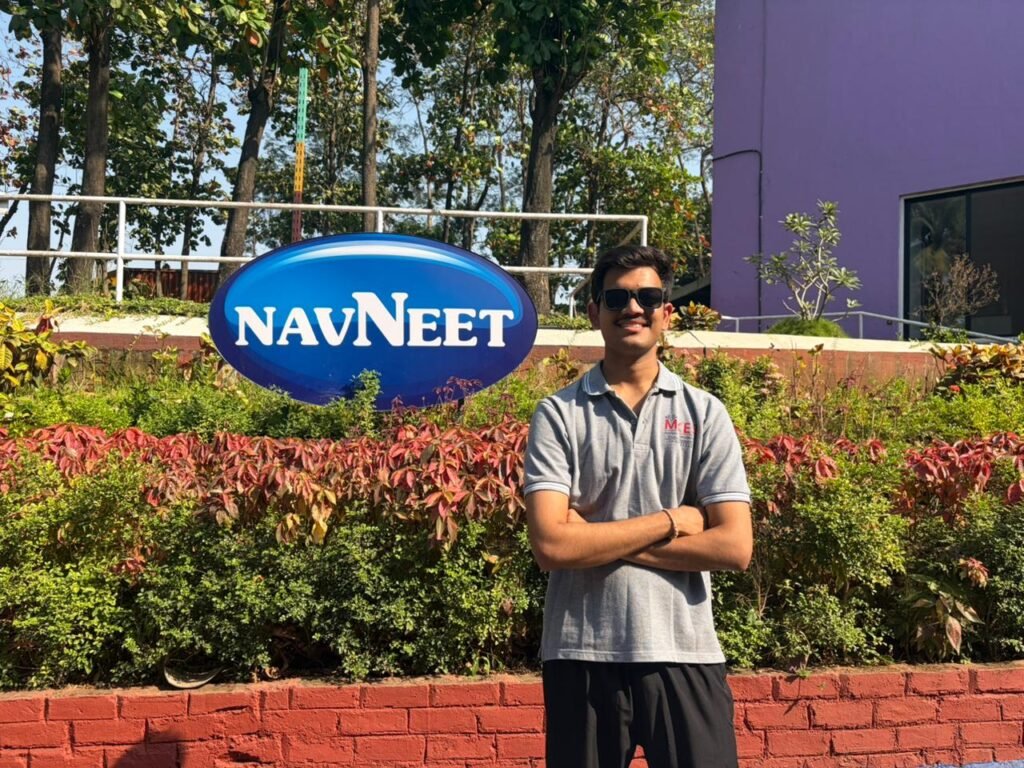
Industrial visits provide a valuable opportunity to understand how industries operate beyond theoretical knowledge. Our visit to Navneet Pvt. Ltd., one of India’s leading educational stationery and publishing companies, was an insightful experience that helped us understand the complete lifecycle of notebook and stationery production—from raw paper to final delivery.
The visit offered a detailed look into Navneet’s manufacturing processes, product portfolio, sustainability initiatives, and technological advancements that enable the company to maintain high standards in the competitive stationery market.
Understanding Navneet’s Legacy in the Education Industry
Navneet has been a trusted name in the education sector for decades. The company has built a strong reputation for producing high-quality notebooks, educational books, and stationery products used by millions of students across India.
Over time, Navneet has expanded its operations to include publishing, stationery manufacturing, and educational content development, making it one of the most recognized brands in the academic support industry.
From Paper to Product: The Production Process
During the visit, we were guided through the entire production flow of notebook manufacturing. The process begins with sourcing and exporting large rolls of paper which are later processed within the facility.
The production flow generally follows these stages:
1. Paper Processing
Large paper rolls are brought into the facility and cut into specific sizes depending on the type of notebook or product being manufactured.
2. Printing Process
Once the paper is cut, it moves to the printing section where lines, designs, and branding elements are printed on the sheets using advanced printing machines.
3. Binding and Assembly
The printed sheets are then arranged, folded, and bound together to form notebooks or other stationery products.
4. Quality Check and Packaging
Before packaging, the products undergo strict quality inspections to ensure printing accuracy, proper binding, and durability. Finally, the finished products are packaged and prepared for distribution.
Observing this process helped us understand the complexity behind producing everyday stationery items that students use regularly.
German Engineered Machines for Precision Manufacturing
One of the most impressive aspects of the Navneet facility was the use of German engineered machines in the production process. These machines are designed to provide high precision, speed, and consistent quality output.
Advanced machinery allows Navneet to:
- Maintain accurate printing alignment
- Improve production efficiency
- Reduce manufacturing errors
- Ensure uniform product quality across large production volumes
The adoption of such advanced technology highlights Navneet’s commitment to maintaining international manufacturing standards.
Diverse Product Portfolio
Navneet offers a wide range of products catering to students, artists, and educational institutions. One of the prominent product lines we learned about was Youva, a premium brand under Navneet.
The Youva brand focuses on creative and premium stationery products such as:
- High-quality notebooks
- Drawing books
- Art materials
- Creative stationery products
Apart from notebooks, Navneet also produces a diverse range of drawing books, sketchbooks, and other stationery items that support students’ creative learning.
Sustainability and Recycling with Zero Wastage
Another fascinating learning from the visit was Navneet’s commitment to sustainability and zero-waste production.
The company follows a recycling process where scratched and unused paper pieces are collected, recycled, and reused to produce new paper products. This approach significantly reduces material waste and promotes environmentally responsible manufacturing.
By implementing recycling practices within the plant, Navneet ensures efficient resource utilization while contributing to environmental conservation.
Educational Collaborations and Publishing Initiatives
Navneet is not only a stationery manufacturer but also a major contributor to educational publishing. The company collaborates with schools, educational institutions, and universities to develop academic support materials.
One such example we learned about is “21 Keys”, a study material series designed to help students preparing for 10th and 12th board examinations. These publications provide simplified notes, practice questions, and structured learning resources to support academic success.
Such collaborations highlight Navneet’s strong role in supporting the education ecosystem in India.
Competitive Landscape
During the visit, we also discussed the competitive environment within the stationery industry. Some of the major competitors of Navneet include well-known brands such as Classmate and Sundaram Books.
Despite strong competition, Navneet continues to maintain its position through:
- Strong brand reputation
- High product quality
- Innovative stationery products
- Strategic collaborations with educational institutions
Understanding the competitive landscape helped us appreciate the importance of innovation and quality in maintaining market leadership.